

Ochrana přírody 6/2025 — 18. 12. 2025 — Summary — Tištěná verze článku v pdf
Summary – Ochrana přírody 6/2025
Hájek P., Melichar V. & Janovský Z.: Sika Deer – a Key Nature Conservation Issue in the Slavkovský les/Slavkov Forest Protected Landscape Area
The presence of non-native Sika deer (Cervus nippon) in the wild in the Czech Republic has been tolerated for several decades. Sika deer are attractive game animals, and therefore, the hunters have no interest in reducing their numbers. The undemanding and adaptable Sika deer has taken full advantage of this. In some areas in the Czech Republic, the invasion of Sika deer has reached such proportions that it is almost impossible to find a natural habitat without having been significantly damaged by them. The fact can be well illustrated by examples of long-term monitoring plant species and communities in the Slavkovský les/Slavkov Forest (west Bohemia). In the past financial year, more than 2,600 sika deer were shot in hunting grounds in the Slavkovský les/Slavkov Forest Protected Landscape Area (611 km2). They very often specifically choose plants that are scarce but tasty to them. Therefore, even a small herd can become a disaster for rare plant species such as the Burnt orchid (Orchis ustulata), the Marsh Fragnant-orchid (Gymnadenia densiflora), and the Early purple orchid (Orchis mascula). The extreme grazing and browsing pressure by sika deer not only decimate specially protected plant populations, but also tree plantings. There is also considerable damage to unsuitable Norway spruce (Picea abies) plantations, which paradoxically results at some sites into the natural enrichment of the forest species composition with the Silver birch (Betula pendula), Rowan (Sorbus aucuparia), Sycamore maple (Acer platanoides), and in some areas even the European beech (Fagus sylvatica). All studies on the impact of overgrazing by sika deer on plant communities have reached the same clear conclusion: it is necessary to radically reduce their numbers. Although the most valuable fragments of ecosystems can be protected by fencing, currently the only real solution for restoring natural phenomena at the landscape level is to increase culling. ■
Šafář J. & Havira M.: Špičák is Not Just about Caves
The landscape north of the town of Jeseník (northern Moravia) offers a large number of low, wooded hills. But only one between the villages of Písečná and Supíkovice hides a number of treasures. Across the Na Špičáku National Nature Monument (NNM), a rocky ridge approximately 260 m long stretches from the north-northeast to the south-southwest, with its highest point, Mt. Velký Špičák, reaching an altitude of 516 m a.s.l. In the gentler terrain below the rocky ridge, flowering beech forests of the Mercuriali perennis-Fagetum association predominate, with the main tree species being the European beech (Fagus sylvatica), Norway maple (Acer pseudoplatanus), Sycamore maple (Acer platanoides), and the Small-leaved lime (Tilia cordata). The tree layer on the steeper slopes is complemented by tree species typical of scree forests, such as the Large-leaved lime (Tilia platyphyllos) and Wych elm (Ulmus glabra). The shrub layer includes the Alpine rose (Rosa pendulina) and several specimens of the Common juniper (Juniperus communis).
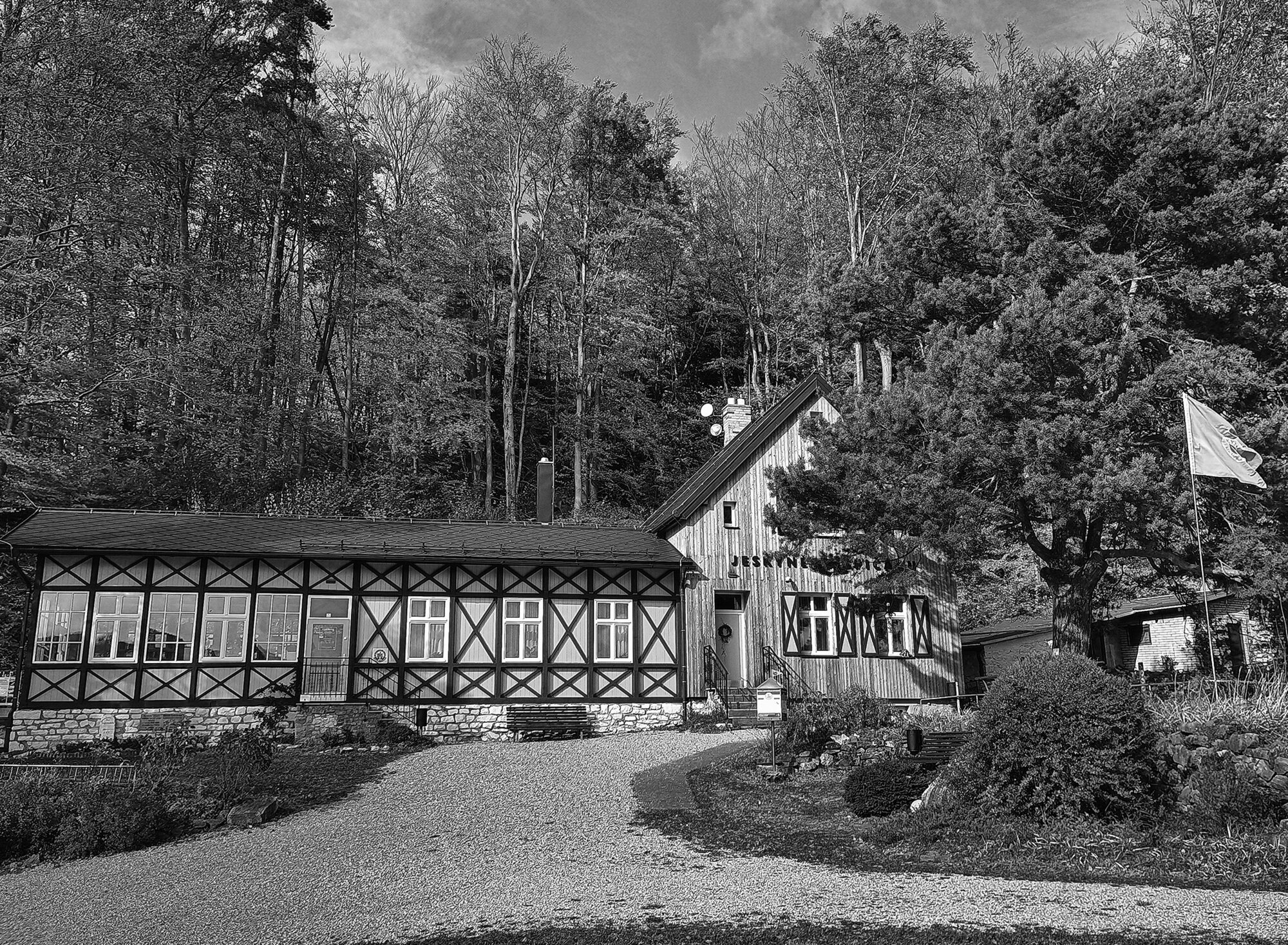
The Na Špičáku Caves Administrative Building. Photo by Miroslav Havira
The highly endangered European yew (Taxus baccata), which occurs across the described stands, deserves a separate discussion. According to a survey conducted in 2023, 258 specimens taller than one meter were recorded there. If local sources of reproductive material are to be used for its further spread or return to the Jeseníky Mts. forests, this is the optimal option. In 2021, the local stands were therefore recognized as a source of reproductive material. Yew trees of all ages are represented there, from seedlings and young trees to individuals around 200 years old. The most significant wild animal group in the Na Špičáku NNM is bats. The area is also included in the European Union´s Natura 2000 network as a Site of European Importance (SEI, pursuant to Act No. 114/1992 on Nature Conservation and Landscape Protection, as amended later, the term for Site of Community Importance, SCI, later Special Area of Conservation, SAC, under the European Union’s Habitats Directive) with the Lesser horseshoe bat (Rhinolophus hipposideros) as the subject of protection. ■
Konvička M., Peškařová T., Fric Z., Tájek P. & Konvičková H.: The Violet Copper Butterfly Extinct, Relocated, and Globally Warmed
Two decades ago, the Violet copper butterfly (Lycanea helle) – a small, neat diurnal butterfly that became extinct in the Czech Republic in the early 1950s – was reintroduced into the country’s fauna. The transfer of part of its population from the Austrian Türnitz Alps was not a classic reintroduction of an extinct species. Today, the originally Alpine violet copper butterflies inhabit the peat meadows of the Šumava/Bohemian Forest Mts. National Park, in the headwaters of the Teplá Vltava River. They share these habitats with cold-loving butterflies such as the Bog fritillary (Proclossiana eunomia), Moorland clouded yellow (Colias palaeno), and the Cranberry blue (Plebejus optilete). Because the Violet copper butterfly os considered to be a glacial relict, several research teams have attempted to model the development of European populations under conditions of climate change. The results are not surprising. The Central European lowlands, including those where the original populations had lived in the Czech Republic and where the butterfly long ago lost its suitable habitats, will cease to be habitable for it in a warmer climate. Dry summers lead to the drying up of meadow wetlands and a visible decline in the Common bistort, also known as the Snakeweed (Bistorta major). On the contrary, suitable conditions will remain in the Czech Republic´s border mountains. The Šumava/Bohemian Forest Mts., Krušné hory/Ore Mountains, Slavkovský les/Slavkov Forest, and Krkonoše/Giant Mountains are all at least 300 m higher than the Westerwald or Ardennes and will remain suitable for the Violet copper butterfly even in radical global warming scenarios. The fact led authors to a heretical idea: to transfer population samples of the Violet copper butterfly from Western European genetic lines, which are unlikely to survive the current warming, to other mountain ranges in the Czech Republic, thus creating a genetic reserve for them. The first candidates for such a transfer are butterflies from the Westerwald and Ardennes mountain ranges. ■
Kadlecová G., Kounek F., Voslářová E. & Večerek V.: Eurasian Beaver (Castor fiber) in the Wild Animal Rescue and Rehabilitation Centres in the Czech Republic
Wild animal rescue and rehabilitation centres help endangered Eurasian beavers (Castor fiber) by caring for injured individuals. Between 2010 and 2024, the number of beavers admitted to the centres in the Czech Republic increased, with the highest number recorded in the Plzeň/Pilsen Region. The most common reasons for admission were beavers falling into holes in the ground or being hit by vehicles. Nearly half of the beavers were successfully returned into the wild after treatment. However, 37 out of the 120 beavers admitted either died or had to be euthanized, mainly due to collisions with vehicles or injuries from being bitten by other beavers or animals. Data from wild animal rescue and rehabilitation centres can help identify risk factors affecting beavers in the wild and may also be used to improve welfare during treatment in these facilities. ■
Boháč O.: How is the Eurasian Sparrowhawk Doing in Central Moravia and the Nízký Jeseník/Low Jeseníky Mountains?
Eurasian sparrowhawk (Accipiter nisus) monitoring takes place throughout the year, beginning with the search for its nests from September to March, followed by checking occupied nesting sites from the end of April, which ends in early August with the last young fledged. The aim of the monitoring is to observe nesting site fidelity, habitat requirements/selection, nesting site protection, and to study food sources at sites where the raptor processes its prey. Thanks to ringing, which identifies adult birds and the subsequent dispersal of young birds, the exact number of young birds in the nest, the sex ratio, and the possible presence of trichomoniasis during ringing have been found. Monitoring and local research show how a seemingly common and widespread species of bird of prey in the Czech Republic can become a rare nesting species in parts of the country, with considerable problems affecting its nesting success. Sparrowhawks have lost more than 90% of their nesting habitat in the Hornomoravský úval/Upper Morava River Valley (central Moravia) and Nízký Jeseník/Low Jeseník Mts. (northern Moravia an Silesia). Some pairs are adapting to the reduced size of suitable nesting habitats, while others are attempting to nest in more “risky” pine or deciduous tree stands, where predation is significantly higher. The Eurasian sparrowhawk continues to be threatened by ongoing logging during the nesting season and consequently, by continued loss of suitable nesting habitats. ■
Kupka J.: The Importance of Agricultural Structures in Velký Roudný Hill for the Survival of an Endemic Snail
Cochlodina cerata opaviensis is a critically endangered endemic subspecies of the Odra and Moravice River basins. Until recently, it was considered a strictly forest species bound to natural scree forests. However, the latest research in Velký Roudný Hill has revealed viable populations on agricultural as balks (stone walls) created by the historical farming practices of the German-speaking population, which was displaced after 1945. The finding expands existing knowledge about the ecology of the species and demonstrates the importance of historical landscape structures for the conservation of critically endangered endemics. The protection of Cochlodina cerata opaviensis should now also include targeted management of these historical structures. ■
Rudolf V.: Drone Flights in Specially Protected Areas in the Czech Republic
Unmanned aerial systems (UAS) and their operation in the Czech Republic do not avoid Specially Protected Areas. Until recently, the operation of UAS in Specially Protected Areas was governed by comprehensive measures of a general nature regulating the restricted (flight) area LKR10 – UAS over the entire territory of the Czech Republic. On August 15, 2025, the Civil Aviation Authority issued a set of new general measures, which, as of September 1, 2025, split the original restricted space LKR10 – UAS into several separate restricted spaces. The purpose of the legal regulation is to preventively establish a stricter regime for UAS operations in Specially Protected Areas due to well-founded concerns about possible disturbance, in particular to birds, by noise or the mere presence of a foreign object. The conditions for UAS operations within the Specially Protected Areas, preliminary information (or preliminary information and a follow-up administrative measure) and the obligation to enter information about the planned flight into a public digital map apply to flights falling within the “open” category of operations. For flights with UAS falling within the “specific” category of operation, different conditions may be specified within the scope of the operating authorization. No specific regulations (in the sense of restrictions) have yet been laid down in general measures for UAS operations within Natura 2000 sites where UAS flights may be particularly problematic in Bird Areas (pursuant to Act No. 114/1992 Gazette on Nature Conservation and Landscape Protection, as amended later, the term for Special Protection Area, SPA under the European Union´s Birds Directive). ■
Jehlička J., Mácová K., Melichar J., Farkač B., Škopková H. & Hanson E. J.: Public Perception of Traditional Forest Management
Traditional approaches in forest management, e.g. coppicing (pollarding) or forest grazing, have been a common feature of the Central European landscape for centuries. In the Czech Republic, however, they have now been almost forgotten. Recently, the alternative, nature-friendly forestry management approaches have been reintroduced – to a limited extent and under specific conditions. While the ecological benefits of these interventions are well documented (which is why we are returning to them), their perception by the public remains poorly researched. The results of research on how people perceive forests are not uniform. In fact, many of them seem to contradict each other. This is because scientists study forests from various point of view and focus on different aspects of forest perception. A pilot survey was conducted online by the authors in the spring of 2025. A total of 142 students from various faculties of Charles University Prague took part in the survey. This will be followed by a survey focusing on the general population of the Czech Republic (the general public). The authors plan to publish the conclusions in 2026 in Ochrana přírody/Nature Conservation Journal as a follow-up article to this pilot study. ■
Hromas J.: 75 Years Have Passed since the Discovery of the Koněprusy Caves
On October 15, 1950, rock monitoring specialists Karel Mareš, František Štěpán, Jiří Jiránek, Karel Chvojka (and, according to some witnesses, also Duha) penetrated the first large part of the Koněprusy Caves (Central Bohemia) within a limestone quarry – today’s Old Passage with Letošník’s Abyss, Kukla’s Dome, and, on their way back, Mareš’s Hall with its beautiful stalactite decorations. The cave was explored by Jaroslav Petrbok and members of the Karst Section of the Natural Science Club of Charles University (later the Karst Section of the National Museum Society) led by Jiří Kukla. The finds were sent to the National Museum, and the caves began to be called Petrbokovy. A period of great discoveries began. Quarrying continued unabated, and the same fate threatened the new caves. František Prošek began archaeological research at the end of 1950 and completed it in 1952. In January 1951, while loading limestone at the foot of the Houbov quarry wall, an excavator uncovered an 11-meter-deep shaft leading to the third, lower level of the caves.

After terminating mining at the Chraberce Quarry in the České středohoří/Central Bohemian Uplands, biological restoration is supposed to be implemented creating a shallow water reservoir, a wetland, a littoral zone and bare rock terraces. Photo by Jiří Bělohoubek

A calyx with arms of the crinoid star belonging to the genus Perunocrinus visible on the Koněprusy Cave wall. Photo by Alexandr Komaško
Between 1953 and 1956, Pavel Radoměrský and Antonín Hejna conducted archaeological research on the upper level of the caves and proved the existence of a medieval coin forgery workshop there. It was decided to open the middle and upper levels of the caves to the public. In 1958, all the preparatory work was completed and the Road and Railway Construction Company (formerly Baraba) began work on making the caves accessible for the public, thus making them a show cave. On August 2, 1959, the caves were opened to the public in a shortened circuit, and the following season, from May 2, 1961, the visitor route was already a closed circuit. ■
Zajíček P.: Zdeněk Burian was Born 120 Years Ago
120 years ago, the world-famous painter of prehistory and adventure, cartoonist, and illustrator Zdeněk Burian was born in Kopřivnice (northern Moravia). His work is associated with the lives of the Earth’s indigenous peoples and the lives of animals and humans in various prehistoric eras. He illustrated hundreds of popular and specialist books and magazines and created scientific reconstructions of the development of life on Earth. Zdeněk Burian’s comprehensive work went far beyond the scope of standard artistic profession. He spent the first years of his life in the town of Štramberk, where he often visited Kotouč Hill with the Šipka/Arrow Cave, where the skeletal remains of Neanderthal man had been found. He was also influenced by the art exhibitions he saw there. Based on photographs taken by travellers and explorers Enrique Stanko Vráza and Josef Kořenský, he drew and painted animals and inhabitants of world´s various parts. Burian’s role model was the famous artist Walter Paget. Ethnography and portraiture therefore became lifelong interests of the artist. ■
Holer T.: Cave Salamanders of Sardinia
Sardinia is one of the major European biodiversity hotspots and a part of the global one. A number of endemic plant and animal species can be found there, among which the cave salamanders of the genus Speleomantes stand out for their uniqueness. Thanks to the diverse geology of the island and the isolation of individual mountain ranges interlinked with karst caves, a total of five species of cave salamanders occur there, which, together with three other species in mainland Italy, are among the only European representatives of the family of the lungless salamanders (Plethodontidae). As is evident from the name of this otherwise most numerous family of tailed amphibians, cave salamanders do not have lungs and breathe only through their skin. In addition, they reproduce by direct development without an aquatic larval stage and therefore need specific environmental conditions for their life, especially high air humidity and relatively low temperature. It is therefore not surprising that cave salamanders are currently threatened, mainly by climate change affecting the microclimate in caves, but also on the surface in their surroundings, where salamanders under suitable conditions forage for food. ■