

Nature Conservation 2026 — 20. 8. 2026 — Preface — Print article in pdf
Preface
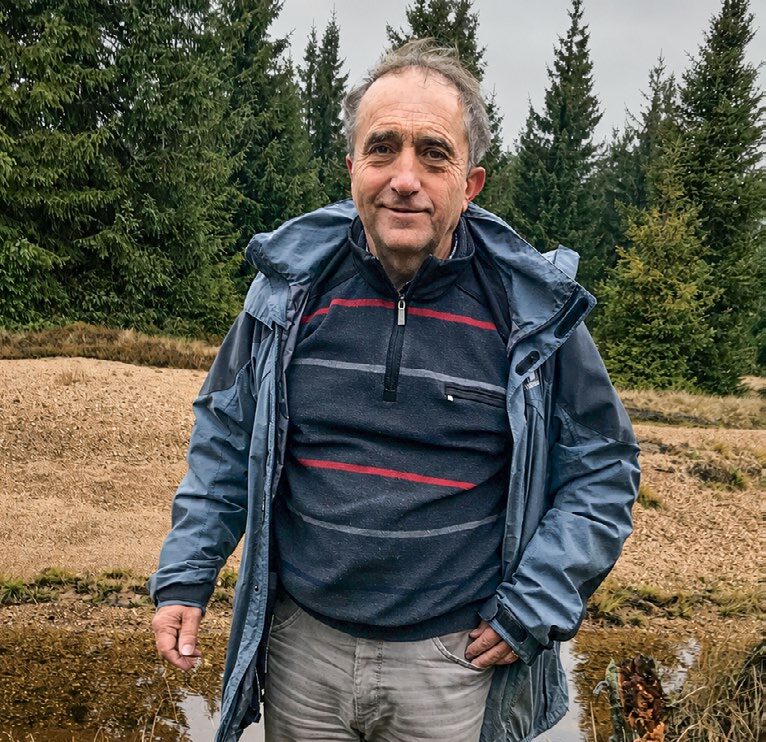
Dear Readers, Dear Colleagues
You are now holding the latest issue of the Ochrany přírody/Nature Conservation Journal for 2025 in English. I would like to add that this issue is being published in 2026 when in the Czech Republic the “Year of Protected Landscape Areas” initiative under the auspices of the Czech Commission for UNESCO has been implemented. The Czech Republic has 27 Protected Landscape Areas (PLAs); the Nature Conservation Agency of the Czech Republic (NCA CR) manages 25 of them, five of which are commemorating significant anniversaries of their establishment. Protected Landscape Areas harbour diverse, unique nature and the landscape where fragments of close-to-natural ecosystems often join managed landscapes and cultural monuments as well (according to the IUCN Category V).
In this issue, you will find a diverse collection of articles addressing what we consider important issues in nature conservation and landscape protection. Thus, we commemorate the 70th anniversary of the designation of the Český ráj/Czech Paradise, the oldest PLA in the Czech Republic, where fragments of unique natural landscapes—particularly rock formations—historical monuments, and sustainable forms of landscape management are seamlessly integrated in an exemplary manner.
Significant insights are also provided by articles focusing on the landscape, e.g limiting the destructive impact on biodiversity caused by overpopulated game ungulates, restoring the water regime, or protecting the insect diversity associated with old-growth trees in forests. A report on the successful collaboration between a landowner and forest manager in a stream floodplain and the State Nature Conservancy, namely the NCA CR, demonstrates the expansion of desirable cooperative management of valuable habitats. Current topics include the prevention wildfires in National Parks as part of providing the proper management of local forests. Interesting are also the articles concerning the legal framework for close-to-nature forest management, the return of the Ukrainian lamprey, perspectives on ecosystem services provided by pollinators, the visitor infrastructure system in Protected Landscape Areas, and the history of land reform in Czechoslovakia in relation to nature conservation.
Nature conservation, in the context of the broader framework of social change and the geopolitical situation, faces and will face fundamental challenges, and addressing them is not and will not be a trivial matter. However, this will not be possible without fully integrating the reality that nature conservation—based on scientific and expert evidence—is one of the key priorities for human society, regardless of political and electoral preferences. The quality of information can easily be overshadowed by its quantity. Moreover, a well-educated society should respond to these challenges more rationally than a poorly educated one. We are, in fact, more dependent on the nature and its associated processes/functions/services than we want to admit to ourselves. Anyone who believes the exact opposite should brush up on his/her basic knowledge of general ecology.
I would like to thank everyone who has been involved in promoting more effective nature conservation, whether as a professional or volunteer conservationist, or as a responsible forest or agricultural manager.
I hope you enjoy reading this.
František Pelc
Director of the Nature Conservation Agency
of the Czech Republic