

Nature Conservation 2026 — 20. 8. 2026 — On Nature in the Czech Republic — Print article in pdf
Sika Deer – a Key Nature Conservation Issue in the Slavkovský les/Slavkov Forest Protected Landscape
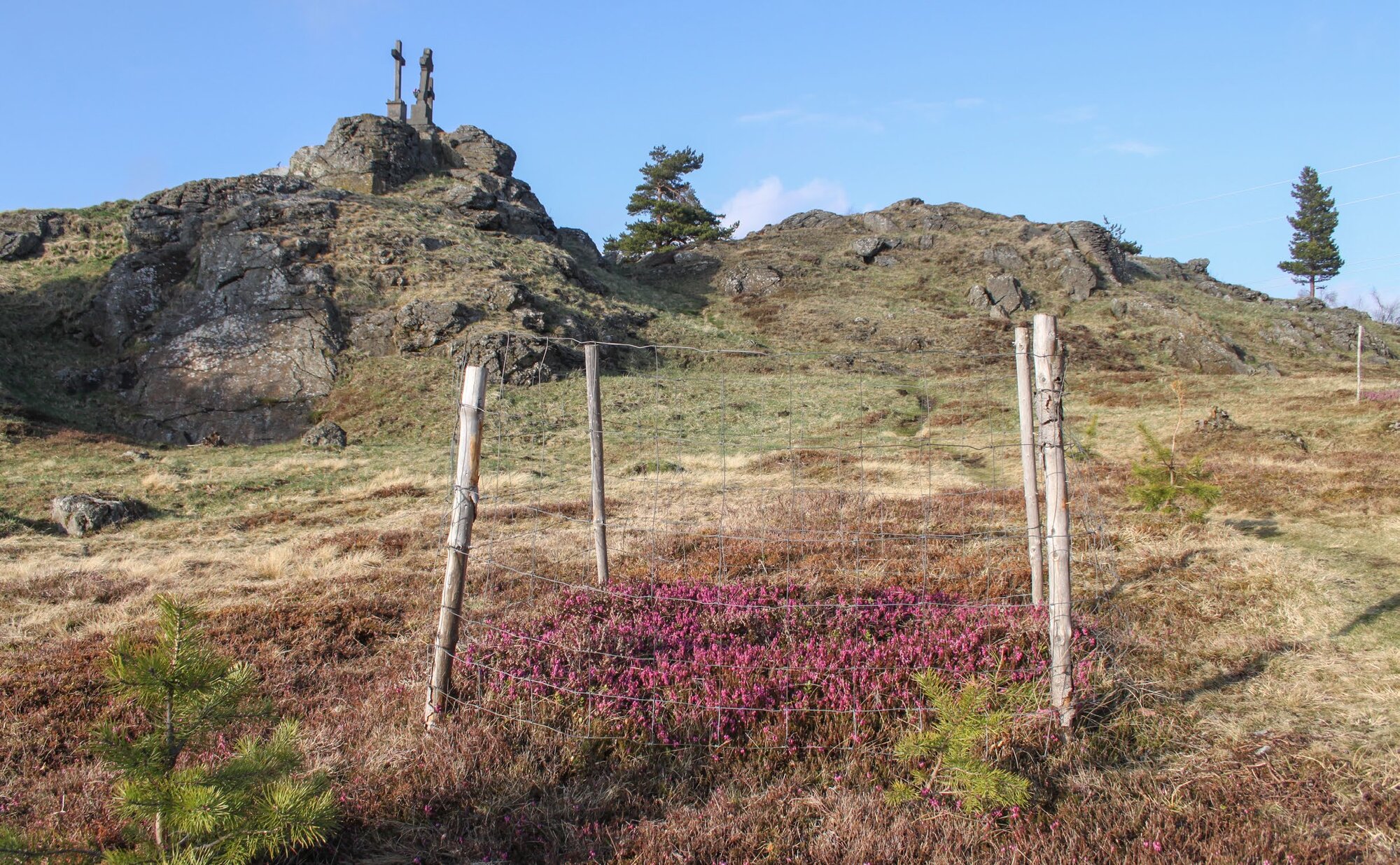
The presence of non-native Sika deer (Cervus nippon nippon) in the wild in the Czech Republic has been tolerated for several decades. Sika deer are attractive game animals, and therefore, the hunters have no interest in reducing their numbers. The undemanding and adaptable Sika deer has taken full advantage of this. In some areas in the Czech Republic, the invasion of Sika deer has reached such proportions that it is almost impossible to find a natural habitat without having been significantly damaged by them. The fact can be well illustrated by examples of long-term monitoring plant species and communities in the Slavkovský les/Slavkov Forest (western Bohemia).
The Sika Deer Population Abundance in the Slavkovský les/Slavkov Forest
The first sika deer was shot in the Slavkovský les/Slavkov Forest in 1963. In the 1990s, the population grew rapidly, and it has been continuing to increase. In the 2024 hunting season only, more than 2,600 sika deer were reported to have been harvested in the hunting grounds within the Slavkovský les/Slavkov Forest Protected Landscape Area (PLA) covering 611 km².
We can illustrate what this means in practice using the example of the Prameny hunting ground (18.5 km²), which encompasses most of the main serpentine ridge of the Slavkovský les/Slavkov Forest (Zone I of the Protected Landscape Area, Sites of Community Importance of the European Union´s Natura 2000 network). The hunting ground includes several Specially Protected Areas (Pluhův bor/Pluh´s Pine Grove National Nature Reserve, Planý vrch/Wild Hill Nature Reserve, Křížky National Nature Monument, Dominova Skalka/Domin´s Little Rock Nature Monument), and others are located in its immediate vicinity (Upolínová louka/Globeflower Meadow pod Křížky National Nature Monument, Údolí Teplé/Teplá River Valley Nature Reserve). According to Decree No. 491/2002 Gazette on the Method for Determining Minimum and Standard Game Populations, the total natural population density of all deer species should be around 60 individuals there—that is, 3.24 individuals per 1 km². However, thermal imaging revealed 478 sika deer alone, or nearly 26 individuals per 1 km² (Macháček et al. 2020). Added to this are another 301 European red deer (Cervus elaphus), or over 16 individuals per 1 km². Although an alternative method of collecting droppings identified slightly fewer individuals (648 sika deer and European red deer combined), the number is still many times higher than what would correspond to the population level prescribed by the Decree. To provide a more complete picture of the game population and its reproductive potential, it should be noted that 69 sika deer and 115 red deer were reported as culled in the Prameny/Spring hunting ground in 2020.
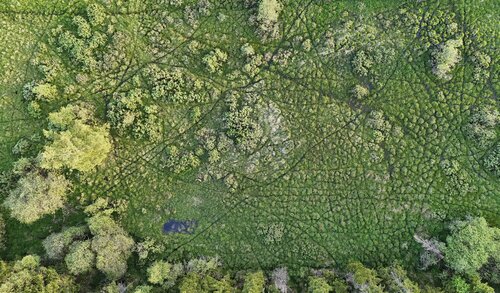
Figure 2. A drone view of the Úpolínová louka/Globeflower Meadow near Křížky documenting high ungulate game population density. The image is from the northernmost, wettest part of the site, where human visitors do not pass through. Photographed in May 2024. © Přemysl Tájek.
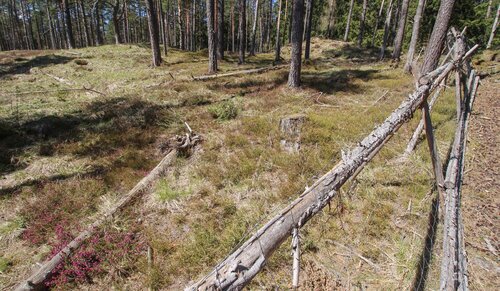
Figure 3. A seventeen-year-old fenced enclosure in the Pluhův bor/Pluh Pine Grove National Nature Reserve built to protect pine regeneration. In the fenced section (left), herbaceous undergrowth with winter heather has fully developed, while in the unfenced section, both the herbaceous and moss layers are almost absent. However, no pine trees have grown within the enclosure to this day—occasional damage to the fencing from blown downs/windfall trees or stem breaks has allowed overpopulated ungulate game to repeatedly destroy the regenerating trees entirely. Photographed in April 2021. © Přemysl Tájek.
Křížky – A Very Last-Minute Rescue
The Křížky National Natural Monument is arguably the most famous natural site in the Slavkovský Les/Slavkov Forest. It consists of a 400-meter-long rocky serpentine ridge, on which, over the past centuries, sheep grazing has helped stabilize a species-rich heathland with rare plants and lichens. The area’s flagship species is the Winter heather (Erica carnea), also known as the Spring heat whose blooming carpets attract visitors from far and wide even before the last snow has melted.
Sometime after 2000, however, the sea of reddish-pink flowers began to gradually disappear from Křížky, and after 2014, the last flowering clumps could only be found on hard-to-reach rocky ledges. The causes of the heathland’s degradation were not entirely clear at first. Initially, suspicion fell on the poor timing of summer sheep grazing, which the PLA Administration has been managing there since the late 1990s, so the PLA Administration launched an experiment to verify this. However, it turned out that the decisive driver in the destruction of the heath population and the entire heathland was winter overgrazing by an extremely overpopulated forest game populations, particularly the non-native Sika deer. The game concentrated at Křížky primarily in late winter grazing on the south-facing slopes, where the snow melts earlier, on sprouting heather and other shrubs (Tájek & Janovský 2016).
In response to the findings, the PLA Administration took drastic measures in 2017 by fencing off the entire Křížky National Nature Reserve (4.5 ha). The very next year, the heathland once again turned red with a beautiful carpet of blooming heather, clearly demonstrating how significant a factor forest overgrazing can be in the conservation of plant communities (Tájek 2024). Access to the site for visitors has been maintained, but they must squeeze through a narrow opening in the fencing. Undesirable, highly competitive grass species continue to be successfully suppressed by summer sheep grazing. A disadvantage of fencing the ridge is that it becomes overgrown with woody plants more quickly, a difficulty that must be addressed from time to time by cutting them back. The massive fencing also does not look natural in the landscape and reduces the site’s aesthetic value.
The Surprising Reason Behind the Disappearance of Globeflowers at Upolínová louka/Globeflower Meadow
The next chapter of our story takes place just across the road, and the plot reaches its climax roughly two months later each year. At that time, a population of more than a thousand globeflowers (Trollius altissimus) blooms in the wetland meadows of the Upolínová louka/Globeflower Meadow National Natural Monument near Křížky. Its popularity is evidenced by the well-trodden paths left by visitors willing to endure wet shoes for a photo featuring as many of the large, spherical, and bright yellow globeflower blooms as possible. Today’s patches of blooming globeflowers, however, are apparently only a faint echo of times long past, as described by eyewitnesses. They often attributed the decline of the globeflowers to improper management of the site, specifically the mowing of the wetland meadows, which was resumed there with the arrival of the 21st century. In fact, globeflowers thrive even in unmown meadows, and the Úpolínová louka/Globeflower Meadow near Křížky was left fallow for the entire second half of the 20th century. Mowing at the site has been still carried out on a rotational basis, with roughly one-third of the meadows mowed each year.
Therefore, in 2014 the PLA Administration launched an experiment across 20 plots measuring 7 × 7 meters to determine which management method would be optimal for both the meadow and for minimizing maintenance costs. A quarter of the plots are left fallow, a quarter are mowed once every four years, a quarter are mowed every other year, and a quarter are mowed annually. Over the past ten years, the globeflower population has unfortunately been slowly declining across all plots—most rapidly in the unmown sites, and most slowly in those mowed annually or every other year. However, when monitoring the globeflowers, the authors did not focus solely on the number of individuals but also on their condition/fitness, and this provided an explanation for the declining population numbers. In some years, up to 90% of all globeflower blooms were grazed. Moreover, overgrazing pressure (measured by the proportion of grazed stems) has intensified over the years. The inevitable consequence has been a long-term, noticeable shortage of globeflower seedlings throughout the population, despite the seeds’ good germination rate, and the impact of grazing has thus completely overshadowed the potential effects of mowing (Janovský 2023, Tájek & Janovský 2024). The culprits are obvious—Sika deer have been observed there more than once in the act. Until the time of the research, however, it had not occurred to anyone that overgrazing by forest game could have such fatal consequences specifically for the globeflower. Wild animals prefer to graze on the flowers after they have bloomed, during the seed-ripening stage, when the stems gradually dry out. It can be assumed that this is due, on the one hand, to the higher nutritional value of the seed-bearing stems and, on the other hand, to their lower or negligible alkaloid content. Globeflowers (like other species in the family Ranunculaceae) are known for its high content of toxic alkaloids, which can cause poisoning even in much larger livestock, but only when fresh. Grazing after flowering is significantly less noticeable, and therefore its consequences had eluded the authors for a long time until the results of a long-term experiment were evaluated.
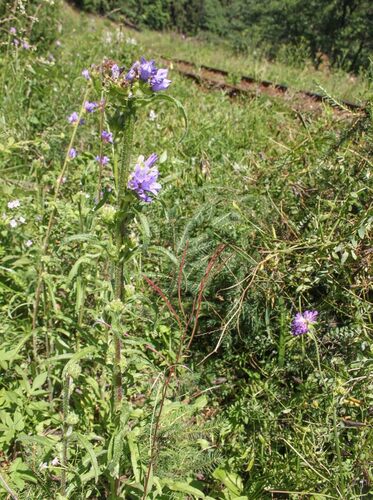
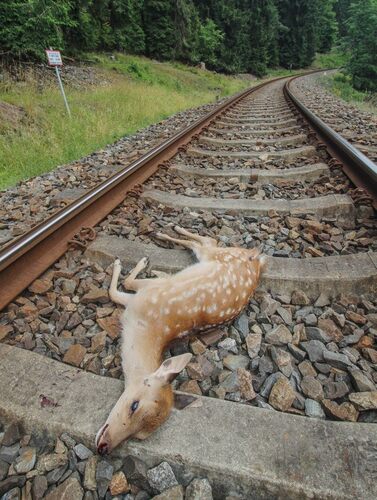
Figure 4. The critically endangered Bristly bellflower (Campanula cervicaria) in the Údolí Teplé/Teplá River Valley Nature Reserve, with the upper part of the stem missing. Most plants are at least partially damaged each year by selective grazing by sika deer. Sika deer populations are so high that animals are regularly killed by trains there. © Přemysl Tájek.
Disappearing Serpentinite Pine Forests
One of the most significant natural phenomena in the Slavkovský les/Slavkov Forest is the relict pine forests on serpentinite, which are protected in the Mnichovské Hadce serpentine area within four Nature Reserves and two Sites of Community Importance. This is the largest serpentinite area in the Czech Republic. Were it not for old photographs in the earliest descriptions of the local vegetation dating from the early 20th century (Domin 1924), it would be difficult for us today to imagine how different and fascinating the habitats there once were. The local sparse serpentine pine forests—or rather heathlands with scattered pines—have, in fact, transformed over the past century into a denser forest with a significant proportion of the Norway spruce (Picea abies).
There are several causes for the changes. One of them is the abandonment of traditional forest management practices—grazing by domestic livestock, litter raking, and controlled burning. Fire likely had kept the forests open (and with a higher proportion of fire-resistant pines) even before human arrival, as evidenced by carbon analyses in soil profiles. The forest there apparently burned periodically at intervals of approximately 170 years (Bobek 2015). In contrast, modern forestry practices and the absence of natural fire events have led to the dominance of spruce and the suppression of herbaceous understory diversity. In recent decades, atmospheric nitrogen deposition and overgrazing pressure from overpopulated forest game have compounded the changes in forest management. Initially, this was evident only in the absence of pine regeneration. Gradually, however, the overpopulated game, namely ungulates, began to significantly reduce the herbaceous layer in the forests there. In some parts of the serpentine ridge, only moss was growing in the undergrowth as early as twenty years ago; today, the situation is even more critical—vegetation is completely absent, leaving only trampled soil and pinecones.
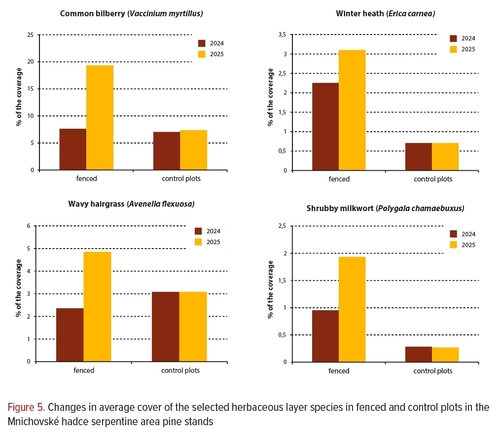
Figure 5. Changes in average cover of the selected herbaceous layer species in fenced and control plots in the Mnichovské hadce serpentine area pine stands
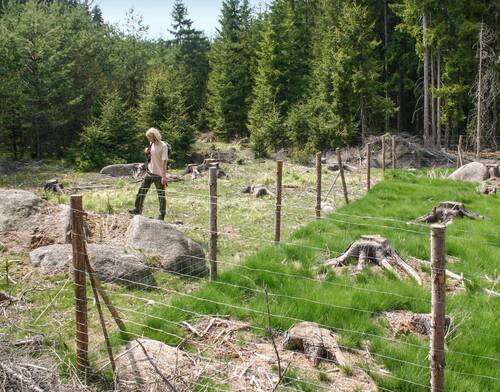
Figure 6. The impact of forest game grazing on clearing vegetation in the Javorná hunting ground (842 ha). The area has long been known for its high sika deer numbers (in 2024, 99 sika deer, 3 red deer, and 19 roe deer were reported as having been harvested there). Photographed in May 2008. © Přemysl Tájek.
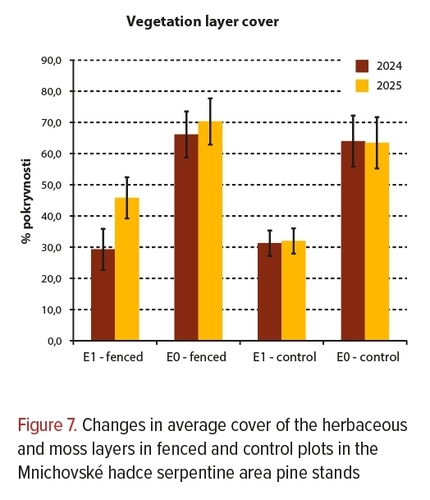
Figure 7. Changes in average cover of the herbaceous and moss layers in fenced and control plots in the Mnichovské hadce serpentine area pine stands
The impact of forest game overgrazing on the herbaceous layer of serpentine pine forests was monitored in the Mnichovské hadce serpentine area in 2007, 2009, 2011, and 2014 as part of small-scale pilot experiments involving pairs of fenced and unfenced vegetation plots. In the fenced plots, the coverage of all shrubs increased significantly, particularly that of the Common heather (Calluna vulgaris) and the Weather heather (Tájek, unpublished data). Due to the growing importance of the topic, a large-scale experiment was established in 2024 on the main ridge of the Mmichovvské hadce serpentine area, comprising 6 pairs of 200 m² study plots, with one plot in each pair fenced. Given the enormous pressure from game, the first results were observable just one year after fencing. The average herbaceous layer cover increased in the fenced plots from 29% to 46%. The greatest increase was observed in shrub cover (Common bilberry – Vaccinium myrtillus – relative increase of 155%; Shrubby milkwort – Polygala chamaebuxus – relative increase of 104%) and some grass species (Wavy hairgrass – Avenella flexuosa – relative increase of 106%; reed grass – Calamagrostis arundinacea – relative increase of 82%). In contrast, there were virtually no changes in areas further accessible to ungulate game, which proves that the suppression of the herbaceous layer was indeed caused by pvergrazing by forest game, particularly big herbivores, dominated by Sika deer (Melichar 2025) – see Graf1, Grafy_druhy.
A similar situation to that in the serpentine pine forests near Mnichov can also be found in the natural pine forests around the town if Bečov nad Teplou and on the Kozí hřbety/Goat Ridge Hills between the towns of Horní Slavkov and of Doubí near the city of Karlovy Vary/Carlsbad Spa. Just ten years ago, carpets of heaths bloomed there in the spring; today, only pitiful remnants have been remaining.
Orchids as a Sought-After Delicacy
Anyone who has ever had the opportunity to watch sika deer or red deer overgrazing up close in the wild knows how selective they are when feeding. Very often, they specifically choose plants that are scarce but to their liking. Therefore, even a small herd can become a disaster for rare plant species such as the Burnt orchid (Orchis ustulata), the Marsh Fragnant-orchid (Gymnadenia densiflora), and the Early purple orchid (Orchis mascula). Long-term monitoring of the Early purple orchid population in the Prameny/Spring hunting ground has shown that the vast majority of orchids are unable to produce seeds due to the grazing on their flowering stems. Thus, part of the population has been protected from overgrazing since 2024 having been using special portable cages. However, closer observation has shown that in this case, the more frequent culprit is the native European red deer, though the Sika deer also occasionally likes to “munch” on them.
A rare bellflower and lichens beneath the hooves of the herds
Another rare species directly threatened by the overpopulation of Japanese knotweed is the Bristly bellflower (Campanula cervicaria)—a sturdy, hairy, and visually appealing biennial. The Údolí Teplé/Teplá River Valley Nature Reserve is likely the last known site of the critically endangered species in western Bohemia, where it grows in a sunny herbaceous strip above the railroad tracks. The local Bristly bellflower population has been monitored annually since 2011, and the location of all found plants is precisely recorded (Tájek 2025). More than half of the flowering bellflowers are bitten off each year. Damaged plants then either produce no seeds at all or only a small number from replacement inflorescences. While globeflowers are long-lived perennials, for this biennial, any significant decline or lack drop in seed production poses a serious threat (bellflowers die after producing seeds in their second year). The impact of forest game ungulates on the Bristly bellflower is not limited to grazing but also includes excessive trampling of the slope and subsequent soil erosion associated with habitat drying. In 2025, the site was therefore fenced off from forest game with the aim of stabilizing the Bristle bellflower population.
The grazing intensity in the Teplá River Valley is also well illustrated by a lichen survey (Peksa 2025). Game overgrazing and movement are key limiting factors for the occurrence of most terrestrial lichen species in the area’s sloping terrain (Fig. 9). In addition to the usual Sika deer, the European mouflon (Ovis aries musimon) also joins the ranks of the culprits there; the latter mammal species is the most significant animal threat to nature conservation in other areas (e.g. the České středohoří/Central Bohemian Uplands or the Křivoklátsko/Křivoklát region, Central Bohemia).
Not all of the sika deer’s impact is negative, but the downsides clearly outweigh the benefits
The extreme overgrazing pressure exerted by sika deer not only decimates specially protected wild plants but also damages tree plantings. There is also considerable damage to unsuitable Norway spruce plantations, which paradoxically results at some sites into the natural enrichment of the forest species composition with the Silver birch (Betula pendula), Rowan (Sorbus aucuparia), Sycamore maple (Acer platanoides), and in some areas even the European beech (Fagus sylvatica). Mature spruce plantings aged 30–50 years are often so damaged by earlier bark stripping and browsing by game that they undergo premature decay, providing an opportunity for the faster regeneration of more species-diverse and stable stands. Disturbance of the soil surface significantly supports populations of certain rare wild plant species—in the Slavkovský les/Slavkov Forest, this is particularly noticeable with the Round-leaved sundew (Drosera rotundifolia) in the Paterák and Smraďoch peat-bogs. Old or only occasionally used deer wallows in the fens are often the last refuges of the highly endangered Common butterwort (Pinguicula vulgaris). On the serpentine ridge, spring areas with old wallows are the sites with the highest coverage of the endemic Mouse-ear chickweed (Cerastium alsinifolium). Intensive grazing and browsing by deer also slow the overgrowth of some valuable wetlands in open areas and forest clearings. Such clearings then provide better refuge for rare heliophilous species—for example, the highly endangered Pyramid bugle (Ajuga pyramidalis) in the Bečov region – see Fig. 10.
The positive effects of deer overgrazing and browsing are a byproduct of their overpopulation and cannot be relied upon massively, as grazing and browsing pressure varies significantly from one site to another. Given current deer populations, it is indisputable that the negative effects far outweigh the positive ones, and the state has been rapidly deteriorating. Furthermore, the decline in traditional landscape management (particularly livestock grazing) exacerbates the problem with deer. This is because deer are left with food sources that would otherwise be utilized by livestock, thereby mitigating the dramatic increase in deer populations. It remains a question for further research why earlier landscape management with widespread grazing was generally positive for species of conservation value, while the current increase in deer grazing and browsing has a clearly negative effect. To answer this question, it will be necessary to study deeper deer grazing and browsing preferences and their spatial behaviour. This differs significantly from that of livestock, in part due to the need to avoid hunters as well as wild predators.
Without increasing the number of culls, a solution is not possible
All studies on the impact of overgrazing and browsing by sika deer on plant communities have reached the same clear conclusion: it is necessary to radically reduce deer numbers. Although the most valuable fragments of ecosystems can be protected by fencing, currently the only real solution for restoring natural phenomena at the landscape level is to increase culling.
Research on forest game grazing on the serpentine ridge in 2024–2025 was supported by the LIFE Integrated Project for the Natura 2000 network in the Czech Republic – LIFE17 IPE/CZ/000005 LIFE-IP: N2K Revisited. We would like to thank the staff of the relevant municipalities with extended powers for providing data on hunting bag sizes: Pavel Nečas, Miroslav Kučera, Hubert Jeřábek, Lukáš Kovář, and Petra Stará. The article utilized results from the ongoing monitoring the effectiveness of management measures, which is conducted by the Nature Conservation Agency of the Czech Republic as part of the management of the Křížky National Nature Reserve and the Upolínová louka/Globeflower Meadow near Křížky National Nature Reserve (Tájek, unpublished data; Janovský 2023). ■
- - - -
Cover photo: Figure 1. One of the experimental plots for monitoring the impact of grazing in the Křížky National Nature Reserve. In the fenced area, the Winter heather (Erica carnea) is blooming profusely, whereas in the adjacent part of the heathland, it suffered from excessive winter grazing by sika deer. Photographed in April 2011. © Přemysl Tájek
- - - -