

Nature Conservation 2026 — 20. 8. 2026 — Nature Conservation Legislation — Print article in pdf
Amendment to the Forest Act – Freedom of Choice at Last
On June 26, 2025, the President of the Czech Republic signed an amendment to Forest Act No. 289/1995 Gazette, 30 years after adoption of the current act. The drafting and discussion of the amendment had evoked much debate and concern about the future of forests in the Czech Republic, particularly in the Chamber of Deputies of the Parliament of the Czech Republic, and had also been accompanied by quite some misinformation. This contribution does not aim to provide an exhaustive list of all changes or comments on them. Instead, we will focus critically on those that were frequently discussed even within circles close to nature conservation community.
Urgent need for change
Across society and the political spectrum, the need to amend the Act was basically undoubted, for several reasons.
I) The current Act was written and adopted in a time of concern about the future of forests returned by the State to various owners, both private and public, as part of the restitution process. For this reason, it included stricter rules which were moreover (and this is the second reason) …
II) … strictly based on the age-class model, because in the era of communism and central planning, we did not know or apply anything else. This meant an 80-year rotation period, a minimum stocking of 7 (or 0.7) years, reforestation within 2 years, securing stands for another 5 years, etc. Those are all regulations for an age-class forest: a uniform, homogeneous forest, typically regenerated artificially. In such growths/stands, the criteria can be measured easily and fairly accurately. However, when dealing working with a more diverse forest (both in terms of species and spatial variation), the criteria for age-class forests cease to apply, and one finds oneself in a legislative vacuum, which was another important reason for the amendment.
III) The previous point relates to the clear need to relax the strict regulations due to the climate change effects, which does not distinguish between forms of ownership. If we want forests to be species-rich, gently mixed, varied in tree height and diameter, with a subtle spatial distribution of growth stages, and where natural regeneration plays a dominant role – i.e. forests where a higher proportion of growth processes is driven by natural forces rather than by humans – we cannot confine them to uniform criteria. That was why practical foresters having experience with non-clear-cutting management models making more use of selective harvesting principles, promoted liberalisation through their organisation, Pro Silva Bohemica.
IV) There are also two social reasons. Over the past three decades, we have seen a rapid change in society in the Czech Republic regarding the expected benefits of forests. Today’s mostly urban population spends more and more time staring at blue-glowing screens, and when they go to the woods to relax, noise from forestry operations, rutted roads (primarily serving the foresters, who built them), and hunting suddenly bother them – and usually the foresters are to be blamed. Forests need to be transformed to stands differing both locally and regionally (=subnationally) in terms of ecology, productivity, and immaterial benefits.
V) Another social reason for amending the Act is, as the author hopes, a shift in thinking regarding the functioning of society. The current Act is written in a way that anyone who deviates from its strict rules can be punished, because we regard them as forest destroyers. This is a legacy of communist thinking, in which everyone was constantly under suspicion. To a certain extent, the Act has been turned to a point where fewer regulations give forest owners or their managers greater creative freedom – and of course greater responsibility. The objective of achieving long-term goals will no longer be just restriction, but greater voluntary motivation – after all, this is a sign of a more advanced society.
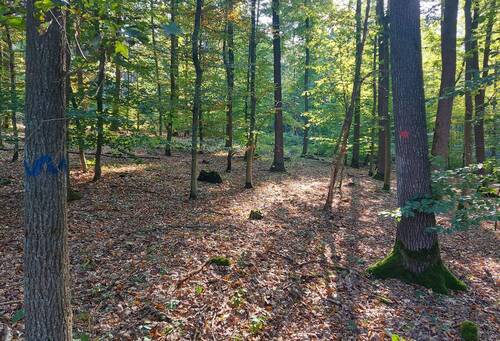
Figure 2. Establishing a habitat tree network in the Bavarian way (trees with a blue wave sign). The forester selects trees of various sizes (e.g. large, medium-sized, and even crooked, substandard trees) at an average of 5 trees per hectare. The trees are not harvested but left to complete their natural life time and then to fully decompose. When a tree dies and its trunk falls to the ground, a new habitat tree is selected from the set of living standing trees there. This ensures a continuous supply of new habitat trees scattered across the property. The forester enters the coordinates, species, and average diameter into a mobile phone app – simple and easy to verify. In return, he/she receives a payment of €100 per hectare per year for providing ecosystem services in the forest. The photo shows Baron Rotenhan’s estate. © Tomáš Vrška.
Forest regeneration
A clearly positive moderation of the Act is the longer period for regeneration of stands/growths from the current 2 years to 5 years, and for reaching the state of established plantation from the current 7 years (2+5) to 10 years (5+5) (Section 31, paragraph 6). NGOs had proposed even longer extensions, and there had also been calls to keep the existing regulations. The current shift is undoubtedly positive, as a 10-year period will allow everyone to regenerate a stand in a fully natural way, even after an initial invasion of pioneer trees. It is of course a political compromise, but it will contribute to a better use of natural forces/drivers in forest regeneration.
However, a more widely discussed regulation was abolishing the obligation to use proportions of ameliorating and stabilising woody plant species (ASWPS) in stand regeneration as prescribed for forests in all forms of non-state ownership. We have heard manipulative statements like: “Now monocultures will be allowed to be grown in forests” (press release Friends of the Earth of the Czech Republic, June 11, 2025). Although we had been legally forced to use the decree-defined ASWPS rate for thirty years, for which seedlings were subsidised, anyone wanting to have a monoculture could have it anyway, because the presence of AWPS is verified at the stage of an established plantation. To make this clear: if an ASWPS proportion of e.g. 25% is mandatory at a certain site, you plant three rows of Norway spruce (Picea abies) and one row of ASWPS (e.g. European beech Fagus sylvatica) and in the first cleaning (after securing the plantation) you cut out the beech rows and thus get a monoculture again. This is done by foresters who do not understand the impact of climate change, and as we can see, not even today’s Act can stop them from doing so(!) and moreover, the State paid the owner money which was actually misused. Such foresters and owners have still been across all types of ownership, but they are really few. The majority of foresters and owners have understood that there is no other way but to shift towards spatially more differentiated mixed stands/growths, including ASWPS in their plantations even without regard to the liberalisation of the Act, i.e. even without the legal obligation, regardless of the increasing trend of applying natural regeneration and pioneer trees. According to the Green Reports of the Ministry of Agriculture of the Czech Republic, between 1950 and 1998 (i.e. over a period of 48 years) the proportion of broad-leaved deciduous trees increased from 12.5 to 22.4% and between 1998 (when Act No. 289/1995 Gazette started to work) and 2023 (over a period of 25 years) the proportion increased from 22.4 to 30.1 %. The acceleration of change in forest species composition is clearly positive and could be even higher, although not because of the law, but thanks to the positive (financial) motivation of foresters, who have learned from the 2016–2020 disaster.
Another frequently applied solution in the application of ASWPS is in the planting method. Simplified, out of a hectare of clearing, 0.75 ha is planted with continuous Norway spruce and 0.25 ha with European beech, i.e. two monocultures are established next to each other. That is of course better than 1.00 ha of spruce, but from a future perspective, beech monocultures at mid- and lower elevations are also wrong, although in accordance with the current Act. Therefore, it was possible to plant monocultures and they have even been planted under the present Act.
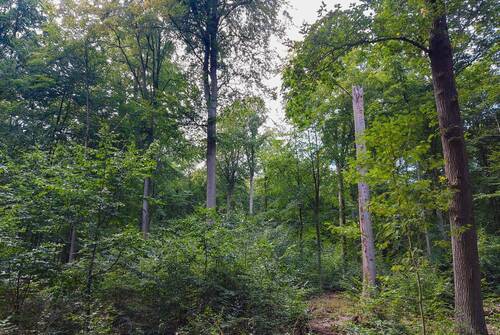
Figure 3. Advanced version of the Dauerwald model for mid-elevations. Tree crown cover (canopy) is nearly 100%, but due to height variation and an irregular patchwork of different growth stages, the light conditions within the stand are highly variable, thus supporting regeneration of oak (Quercus spp.) and biodiversity in general). Yet measuring stock density in such a stand is irrelevant, given the way the criterion is defined. The amendment to the Forest Act paves the way for adoption of non-clear-cutting management models. © Tomáš Vrška.
Ecosystem services and decaying wood
The amendment to the Act introduces the institution of payments for ecosystem services (newly in Section 46b), with conditions for providing payments set by government regulation. This is a new and important provision, although the introduction of a government regulation is not time-limited and will certainly be non-entitled like previous Government Regulation No. 30/2014 Gazette, according to which management contributions are provided. If payments for ecosystem services are well defined, this can significantly motivate owners to gradually convert their forests to mixed, structurally and texturally differentiated forests. Experience abroad where these services are already paid for (Ireland, Luxembourg, Switzerland) shows that finding relatively simple criteria is essential.
The long-discussed and undeniable need to leave a relatively large amount of decaying wood in forests remains a task for the Ministry of Agriculture of the Czech Republic by preparing a decree setting a minimum amount of (parts of) logging residues and trees intended for decay (Section 33, paragraph 8). It is true that no consensus on this issue was reached during the negotiations on the amendment. Therefore, implementing a decree prevailed as a solution. Proposals like an obligation to leave a certain number of trunks after the final felling for decay were not included into the Act. In close-to- natural forest management, where we do not distinguish between improvement and regeneration felling, this is an unmeasurable criterion, as we always harvest very different trunk diameters at the same time. For practical use in the Czech Republic, the simple and practical Bavarian model is available, which operates by means of a simple mobile phone application also used by the State/Public Administration providing financial contributions to owners during inspections.
For nature conservation and providing ecosystem services, enabling forest grazing is an undeniable benefit. This is criticised for the loss of production, but it should again be the owner’s free decision – does he want to graze and have a destroyed or limited production of quality wood? That is his/her choice. On the other hand, grazing can contribute to a local increase in biodiversity, but will always be a minority issue, supported more by the State Nature Conservancy authorities and NGOs/non-profit organizations.
A clear benefit is the possibility of creating pools up to 1,000 m2 in size in forests without the need for a building permit. This way we can very quickly – with well-set motivational support – shift more toward retaining water in the forest or the landscape as well as in supporting biodiversity, which is good for everyone – the forest owner and society.
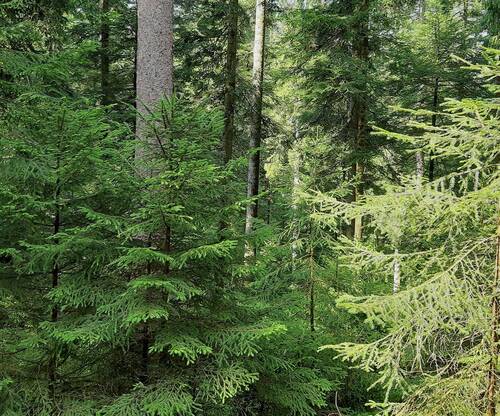
Figure 4. Transition to a selection forest, 50 years after the original stand consisting mainly of Norway spruce. In some stands (the smallest permanent forest unit to which of ameliorating and stabilising woody plant species (ASWPS) rate assessment applies, the ASSWPS rate in natural regeneration does not meet the required proportion mentioned in the regulation. Neither the forces/drivers of nature nor the forester using them acted in accordance with the law there (!). The shift of financial support for ASWPS rates to incentive tools will make these funds being used sensibly rather than at any cost. Photo by Tomáš Vrška.
Economic and management parameters
The departure from the narrow concept of forest age classes, as set in the current Act, includes abandoning the stocking density criterion for assessing the rate of stand thinning before regeneration. To date, an over 80-year-old stand/growth below a stocking density of 0.7 could not be thinned, whereas now stocking density is replaced with the term canopy (tree crowns of the stand) which should not fall below 6, or 0.6 of the full canopies. This will no longer legally prevent a more significant diversification in tree diameter and height of a stand, because with a greater evenness of growth stages within one stand group, stand size measurements are biased. Canopy assessment is simpler and more objective for forests homogeneous in age classes as well as for diversified stands. In a diversified stand, stocking density may fluctuate, but its canopy may remain more stable, which is more important from the perspective of ecological (and therewith production) forest criteria.
The issue of reducing the rotation period for forest stands of different age classes from the current 80 years to 60 years (Section 33, paragraph 6) have also been discussed. The reason for that is clear: an effort to save at least part of the production from existing Norway spruce and Scots pine (Pinus sylvestis) stands, which will continue to face climate extremes and disasters to come – which is just a question of time. But this is not only a financial issue but makes communicating vessels with the future form of forests. If we regenerate formerly even-aged stands with clearcutting or structuring interventions, or a combination of both, we will get better conditions for conversion without large disaster/calamity clearings – also thanks to the sale of non-calamity wood at a higher price, finances for including absent broad-leaved deciduous trees, whose seedlings are more expensive and whose stands require more demanding management than the usual conifers, Norway spruce and Scots pine.
More diverse forests and their management cannot be imposed generally
Why do countries most advanced in forestry, which are an example in openness of thought and new approaches, have had the simplest forest laws? It is because they had given up on uniform age-class forests earlier than we did, and know that a monotonous uniform forest cannot be transformed into a forest with an irregular structure and a delicate mixture of tree/woody plant species with criteria for an age-class forest. If we use more natural drivers/ forces in the process of forest cultivation/silviculture, we cannot expect them to behave “as the law dictates”, according to uniform rules. Therefore, the Czech branch of the Pro Silva initiative, bringing together practical foresters who practise close-to-natural management (no clear-cutting), has been actively involved in elaborating the amendment from the beginning and supports it. It is important to realise that foresters who have been managing the forest without clear-cutting for thirty years are in conflict with the current Act in many aspects, e.g. concerning the use of ASWPS (Fig. 2).
We are certainly all aware that a diverse forest = fewer regulations = greater responsibility of the practising forester. However, for the desired forestry transformation, three conditions must be met: (i) the forester has to want it, (ii) the forest owner allows or even requires the forester to do so (i.e. he “may” do so), and (iii) the forester has to be able to do it. Condition (iii) means he has to learn it somewhere, but he can only learn it from someone who has already been doing it and has tangible results. Thus, theory is not sufficient. But try to convince a more cautious person of a change which is strongly blocked by existing legislation! We therefore need a liberal forest act. ■
- - - -
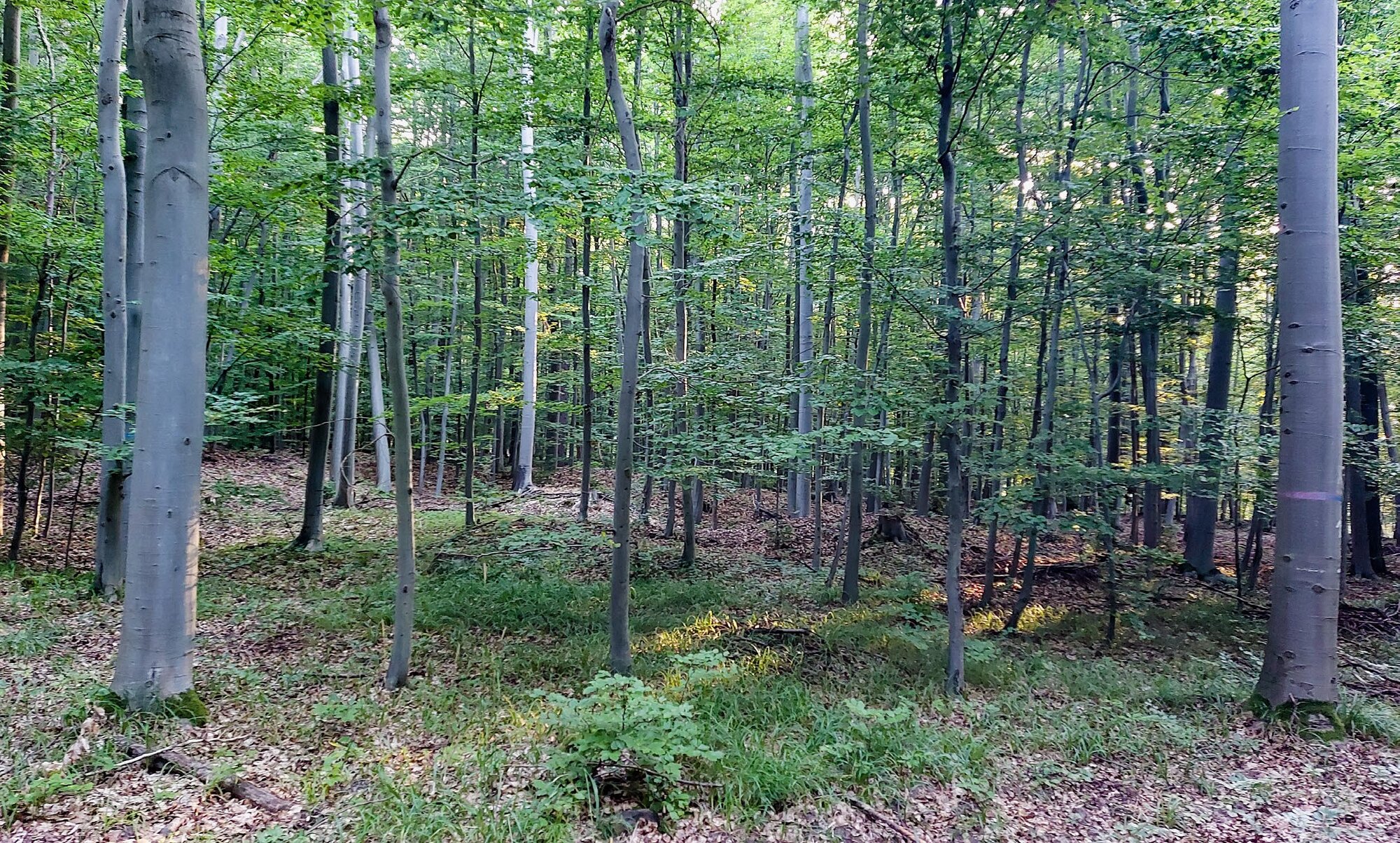
Cover photo: This is also what an even-aged European beech (Fagus sylvatica) monoculture created by multi-stage shelterwood cutting may look like. Differentiation in both thickness and height is caused by the forester’s intelligent work with the trees’ response to clearing as part of a transfer to the model of value incremental beech management. Terms like age, stocking density, or rotation gradually lose their meaning there. Instead, total current increment, tree diameter class distribution, and target diameter for felling are key terms. © Tomáš Vrška.
- - - -