

Nature Conservation 2026 — 20. 8. 2026 — From the History of Nature Conservation — Print article in pdf
75 Years Have Passed since the Discovery of the Koněprusy Caves
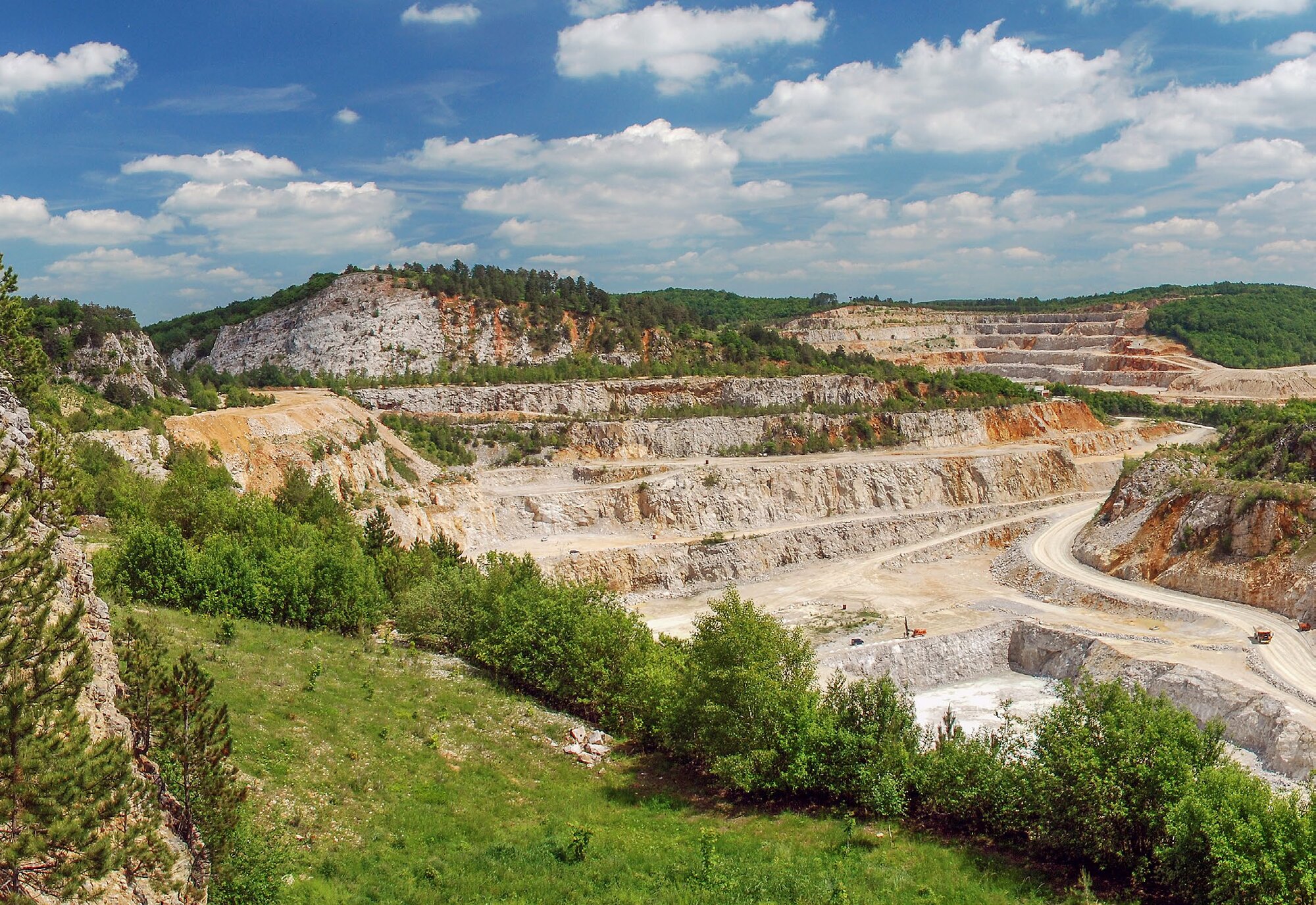
“It wasn’t until we were inspecting the quarry on September 14, 1950—Director Pastora, Foreman Frič, Duha, and me, Karel Mareš—that I was walking above the quarry when I reached a spot where the quarryman Frant. Štěpán called out to me, ‘Foreman, I just found a hole in the quarry wall after the blast. There was a hole 10 meters long, 4 meters wide, and 3 meters high. A 13-meter-long passage leads from this cave…” recalled Karel Mareš, foreman of the Houba´s Quarry at Zlatý kůň/Golden Horse Hill near the village of Koněprusy (Central Bohemia), in his memoirs in 1997.
The First Major Discoveries
The “hole” in question was explored by quarrymen (stone breakers) Foreman Karel Mareš, František Štěpán, Jiří Jiránek, and Karel Chvojka. It was located in the quarry wall just a few dozen meters from the entrance to the long-known Ztracená sluj/Lost Cave (also called Bábina/Grandma), a hideout for shepherds, vagabonds, and perhaps even various unsavory characters. By coincidence, at that very time, Petrbok’s boys—Radvan Horný (18), Ivo Chlupáč (19), and Jiří Kovanda (15)—were digging test pits there for Jaroslav Petrbok (69), a researcher of the Český kras/Bohemian Karst. And as was customary there, the quarrymen reported their discovery to Petrbok himself. Within a few days, his boys connected Bábinka/Grandma to the newly discovered passage via a tunnel, and quarryman Štěpán even dug his way through it to long-forgotten chambers with a small lake.
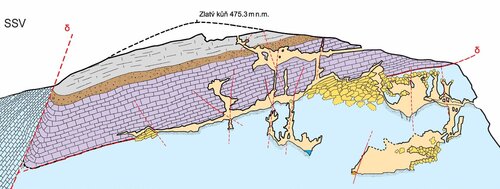
Figure 2. North-south cross-section of the Zlatý kůň/Golden Horse Hill showing the geological structure of Devonian limestones and the three levels of the Koněprusy Caves. © Josef Mottl
On October 15, 1950, quarrymen Karel Mareš, František Štěpán, Jiří Jiránek, Karel Chvojka (and, according to some witnesses, also Duha) penetrated the first large part of the Koněprusy Caves within a limestone quarry – today’s Stará chodba/Old Passage with Letošník’s Abyss, Kukla’s Dome, and, on their way back, and on the way back, they also stopped by Mareš´ Hall, which features beautiful cave speleothem decoration. Beneath the chimney near the abyss, they found rotten wood, glass and bone beads, shards of medieval pottery, animal bones, coals and cinders, and a piece of a hollowed-out log with remnants of copper shavings. Someone had been there before them.
The cave was explored by Jaroslav Petrbok and members of the Karst Section of the Natural Science Club of Charles University (later the Karst Section of the National Museum Society) led by Jiří Kukla. The finds were sent to the National Museum, and the caves began to be called Petrbok´s Caves.
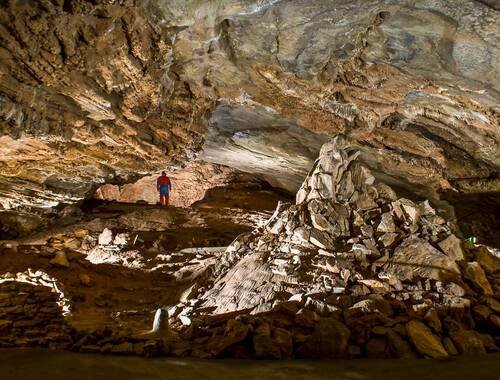
Figure 3. The slope beneath the chimney in Prošek’s Dome, the site of major archaeological finds.
© Alexandr Komaško
A period of great discoveries had begun.
On October 18, 1950 Kukla descended into the abyss and found human footprints at a depth of about 30 meters. Two days later, however, Vlastimil Letošník, Assistant Professor at the Institute of Geography at Charles University Prague, fell while rappelling the last few meters, and the footprints were destroyed during the rescue operation. The abyss retained the name Letošník´s Abyss. After the accident, the quarry administration restricted access to the caves to experts only.
On November 5 (according to Stárka, November 6), near Letošníkova Chasm, Kukla, Jan Budák, and Petr Batík widened a small opening with a draft, but only twelve-year-old Petr managed to squeeze through the narrow passage. He discovered the domes of the New Cave (a name no longer in use)—U strážce/Neat the Ranger Dome (now Petrbok´s Dome) and Petr´s Dome. He could have gone further, but since he was alone, he disciplined himself and returned. It was not until a week later that Jiří Kukla’s group managed to widen the crawlway to accommodate bigger speleologists, penetrate the subsequent Pustý dóm/Empty Dome and Hlavní dóm/Main Dome (now Prošek´s Cave), and make the first archaeological discoveries there.
As was customary in quarries, the caves exposed by mining were always a welcome target for collectors of natural specimens before their subsequent destruction (this time, part of the cave speleothem decoration in Mareš´ Hall fell victim to them). The quarrymen always hid the stalactites, crystals, fossils, any skeletal remains, or other curiosities they found for “Professor” Petrbok (usually in exchange for a pack of tobacco), who frequently visited the quarries. This time, too, mining proceeded relentlessly, and the same fate threatened the new caves. While the cavers continued to uncover and make initial maps of the new areas, Petrbok called on the quarrymen and Kovanda and his mother to salvage whatever they could from the caves. This mainly concerned the numerous bones lying on the surface of the debris cone beneath the chimney in the Hlavní dóm/Main Dome. On November 15, Foreman Mareš found a woolly rhino skull there, which Kovanda carried to the surface through narrow crawlways. Two days later, along with a number of other bones, Mareš carefully brought up Kovanda’s Basque beret with his discovery of the crushed rear portion of a human skull.
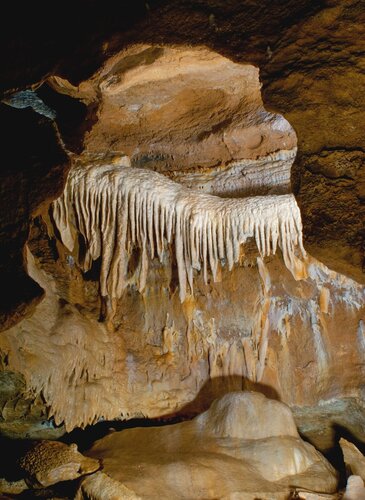
Figure 4. The stalactite Varhany/Organ, a traditional promotional image of the Koněprusy Caves.
© Alexandr Komaško
On December 4, Kukla and Miss Zárubová climbed a 14-meter chimney from the Staré chodby/Old Passage to the top floor and discovered the remains of a Middle Ages mint there.
It was high time to take action to save the caves. Therefore, on December 6, under Kukla’s leadership, the Karst Committee of the Czechoslovak National Research Council met, and it was agreed not to continue mining in the wall with the entrance to the cave. The State Archaeological Institute was tasked with establishing a commission of experts and relevant agencies to determine the next steps. The Commission, led by the Director of the State Archaeological Institute, Academician Jaroslav Böhm, met on December 18 at Zlatý kůň/Golden Horse Hill and entrusted the research of the caves to the State Archaeological Institute, the Central Geological Institute, and the Karst Section of the National Museum Society.
Petrbok was no longer invited to participate. He had to hand over the finds he had been bringing to the National Museum to his student, the archaeologist František Prošek. He took it hard, but the new researchers were no longer willing to tolerate his research methods. When one of the chimneys was broken through to the surface from the Hlavní dóm/Main Dome in December 1950, making the cave more accessible for research, Petrbok and his colleagues descended into the cave for the last time.
Archaeological Research and Its Findings
František Prošek began the archaeological research in late 1950 and completed it in 1952. The main contributors were palaeontologist Zdeněk Hokr, geologist Jiří Kukla, palaeontologist Oldřich Fejfar, and anthropologist Emanuel Vlček. Following the initial findings from the course of the discoveries, Prošek focused primarily on the Hlavní dóm/Main Dome, while the palaeontologists also examined all skeletal remains from other, predominantly central parts of the cave system. Remains of the following species were found in varying numbers—woolly rhinoceros, horse, red deer, grey wolf, chamois, goat, cave hyena, bear, hare, marmot, bat, vole, dormouse, and other rodents, as well as molluscs dating from 10,000 to 1.5 million years ago.
Nevertheless, the most significant find was human remains—a lower jaw, fragments of the supraorbital and occipital regions of the skull, fragments of the right and left zygomatic bones, a rib fragment, a cervical vertebra, and three thoracic vertebrae. Initially, the prevailing opinion was that these belonged to multiple individuals; later, it was proven that they are parts of a single woman. Her grave goods likely included three stone tools (a quartz flake with traces of retouching and two flakes of metamorphosed Liteň slate), a drilled sea mussel shell (from a necklace), and a flake of thick hollow bone with a notch. The woman’s grave was likely located in the sediments in the subsurface part of the chimney, from where it gradually collapsed into the cave. Despite the skull’s striking archaic features, its age remained undetermined for a long time. It was not until 2023, thanks to the work of anthropologists Petr Velemínský and Jaroslav Brůžek, that the Max Planck Institute in Jena succeeded in proving through DNA analysis that the woman lived at Zlatý kůň/Golden Horse Hill at least 45,000 years ago, her ancestors interbred with Neanderthals another 2–3 thousand years later, and she belonged to an extinct branch of anatomically modern humans. She is one of the oldest Eurasian inhabitants following the expansion from Africa. The find is the only preserved, nearly complete skull from that period, having really been a global sensation.
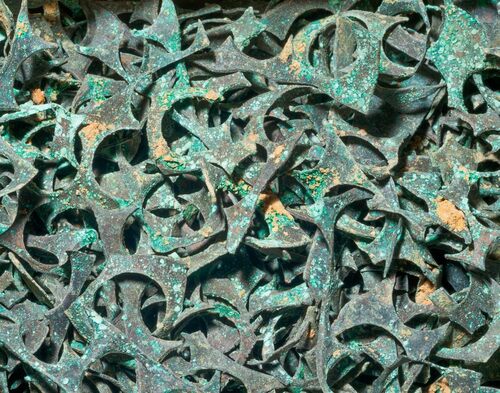
Figure 5. Scraps of copper sheet from the Mint at Zlatý kůň/Golden Horse Hill, remnants from the production of counterfeit coins. © Alexandr Komaško
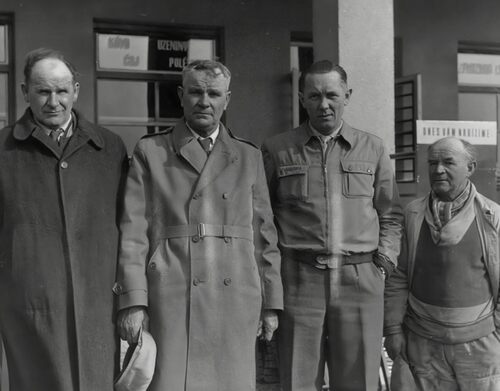
Figure 6. The discoverers of the Koněprusy Caves—quarrymen Štěpán, Mareš, Jiránek, and Chvojka in front of the Koněprusy Caves building in 1960. Photo: © Cave Administration of the Czech Republic—copy
Rebeka Rmoutilová and the French researcher É. Daynés carried out the reconstruction of the skull and, subsequently, the entire appearance of the prehistoric woman. Based on the published data, Brazilian 3D designer Cicero Moraes repeated the procedure.
Further Discoveries
In January 1951, while loading limestone at the base of the Houba´s Quarry wall, an excavator uncovered an 11-meter-deep shaft leading to the third, lowest level of the caves. The mostly straight, high passages in the Koněprusy limestone are accompanied there by a series of small chambers with unique decorations of glassy, eccentric speleothems. To prevent the valuable speleothem decorations from being destroyed, the shaft was covered again after the cave was explored and mapped, and was intentionally forgotten for a long time.
On February 17–18, 1951, Zdeněk Březina discovered the Březina Chambers, a very difficult-to-access area on the middle level.
On August 10, 1951, the original counterfeiters’ entrance to the Mint was finally found and opened. It is just a small rock window in the remains of a medieval quarry on the Zlatý kůň/Golden Horse Hill. It was covered with a stone just a few decimetres below the grassy surface.
On September 8, 1951, while cleaning the wall of the Houba´s Quarry in areas where mining was still ongoing, quarryman Bartoníček discovered an opening, which he and Mareš and Štěpán widened; through a spacious passageway, they made their way past the “Věčná touha/Eternal Longing” stalactites to a formation called “Varhany/The Organ.” The speleologists then continued through a narrow crawlway from Varhany/The Organ to the U labutě/Swan Hall and named the entire cave Zářijová jeskyně/September Cave after the date of its discovery.
On December 22–23, Stárka, Kukla, and Batík dug a long, narrow squeeze from Varhany/The Organ to a chamber, which they logically named Vánoční/Christmas Hall.
When Zářijová jeskyně/September Cave was subsequently connected to Mareš´ Hall by a short passage, the major discoveries in the Koněprusy Caves were completed for a long time.
Research at the Mint
Between 1953 and 1956, Pavel Radoměrský and Antonín Hejna conducted an archaeological survey of the caves´ upper level and confirmed the existence of a medieval counterfeit coin workshop there. The cave’s layout, along with the discovery of hearths, furnaces, ceramic vessels, and oil lamps, remnants of a coin die, scraps of copper sheet (cissures), uncut discs (blanks), rejects of counterfeit coins, a stamp (or punch?), and other items demonstrated that around 1469, during the reign of George of Poděbrady, King of Bohemia, counterfeit small coins, also known as Hussite halers, were secretly minted in the cave. The blanks were cut from copper roofing sheet, silver-plated by dipping in silver amalgam and annealing in fire, and subsequently stamped once with a double-tailed Czech lion surrounded by a pearl astragal. Total production is estimated at 5,000–10,000 pieces.
The first use of a punch in the 15th century in the Kingdom of Bohemia (the state mint had been still cutting out the pieces by hand), the high quality of the steel used for the punch (or die?), which was previously unknown from that period, and the first discovery of a complete eight-piece set of small weights made from talc balls highlights the extraordinary significance of the find.
Opening the Caves to the Public
It had been decided to open the middle and upper levels of the caves to the public, thus making show caves there. In 1958, all preparatory activities were completed, and the Road and Railway Construction National Enterprise (formerly Baraba) began work on making the caves accessible. On August 2, 1959, the caves were opened to the public on a shortened tour; the following season, starting May 2, 1961, the visitor route was a closed loop. The investor, the District National Committee in Beroun, established the Stalactite Caves Centre at Zlatý Kůň/Golden Horse Hill near the village of Koněprusy. Exploration and research of the caves did not continue; speleologists were only allowed to visit them as tourists.
Over the next few years, the cave administration, acting on its own initiative and always during the off-season, continued with further modifications to the caves, including the concreting of walkways and surfaces and the extension of the visitor route to the Stará chodba/Old Passage and the U labutě/Swan Hall.
Last Major Discoveries
It was not until 1962, following personnel changes in the cave administration, that speleological exploration could resume in the Koněprusy Caves. Under the cave administration (later as part of the Local History Club of the Beroun District Museum), the Český kras/Bohemian Karst Speleological Club, led by the author of this article, began its activities; together with members of the Karst Section, they resumed extension work at Zlatý kůň/Golden Horse Hil.
In February 1962, speleologists rediscovered and opened a forgotten chimney leading to the Spodní patro/Lower Level and dug through a previously silted-up crawlway into its main chambers. Although they managed to find an impassable connection to the nearby Sláva´s Abyss in Houba´s Quarry, no part of the Spodní patro/Lower Level offered any hope of continuing the exploration. Therefore, during the 1st speleological camp at Zlatý kůň/Golden Horse Hill, Pavel Nosek focused on the fissures and chimneys in the high ceilings of the chambers. On July 23, 1965, he dislodged several wedged stones high up in the ceiling of the Hlavní chodba/Main Corridor and opened access to an unknown chimney. A day later, he and the author of this article climbed through it to the level of the middle floor, discovered what is now known as the Nová jeskyně/New Cave with the “By the Mosque Stalagmite” passage, and, guided by a beam of light, dug their way to the surface through the quarry wall. On September 1 of that same year, guided by a draft, Nosek dug through a narrow passage into the Síň trosek/Hall of Ruins, Peklo/Hell, and the largest dome of the Noví jeskyně/New Cave—the Kavárna/ Café. It was certain that these spaces were already located near the Březina´s Halls, but they were separated by an extensive collapse of massive boulders and rock blocks from the collapsed ceilings.
On February 20, 1966, members of the club, led by Březina, Nosek, and the author of this article, cleared narrow passages between the blocks of cave-in and established a connection between the Kavárna/Café in the Nová jeskyně/New Cave and Březina’s Halls on the Prostřední patro/Middle Level. Two groups, moving toward each other, searched for and gradually cleared the connecting “path.” This historic moment marked the culmination of the discoveries in the Koněprusy Caves. All three levels were connected into a system with a total length of 2,050 m and a depth of 70 m.
What’s next?
The global significance of the discovery of human remains clearly calls for the resumption of archaeological research in the Koněprusy Caves. Greater attention to the mineral content of the caves, its succession and genesis—particularly in connection with the documentation and exploration of cavities gradually being uncovered in the Velkolom Čertovy schody/Devil´s Stairs Quarry—also offers new insights into the development of the Český kras/Bohemian Karst. For speleologists, there have still been plenty of unexplored sites at Zlatý kůň/Golden Horse Hill and its surroundings. There are several topics that could pose a challenge for relevant specialized institutions and their researchers. The Cave Administration of the Czech Republic itself could serve as the initiator and subsequently as the entity that communicates new findings to the public as part of its educational mission. ■
- - - -
Cover photo: The Zlatý kůň/Golden Horse Hill National Natural Monument, which includes the Koněprusy Caves, is now surrounded by the Čertovy schody/Devil´s Stairs Quarry open-pit mine (Centra Bohemia). © Josef Mottl
- - - -